Losing Innocence and Truth: Chemistry, Folly, and the Nazi Embrace.
If the first casualty of war is innocence, as Oliver Stone asserts in his film Platoon, the second is certainly truth. I had intended to write a detailed description of why Holocaust deniers are ill-intentioned and how their so-called “chemical facts” are nothing more than false and tendentious narratives. I even read one of the most cited books supporting this campaign of historical discredit. In the end, I realised that even the few words spent thus far grant too much visibility to the revisionists. The truth is that Nazi Germany exterminated 1.1–1.5 million human beings in the Auschwitz-Birkenau camp alone. Many of these were Jews, according to a long-planned project for the extermination of the Jewish people.
This, then, will be an account of how chemistry and the madness of Nazism and Pan-Germanism converged.
A Necessary Premise
Chemistry is a formidable science, an engine of development, an arrow pointing toward progress. Chemistry is the science of transformation, explaining to us why and how certain reactants transform into products that we can design almost at will. It is the science that finds the innovation that decisively improves human life. In 1910, Fritz Haber, later awarded the Nobel Prize in 1918 for his discovery, developed the synthesis of ammonia from atmospheric nitrogen. This technological revolution enabled the production of fertilisers then and now, and its almost immediate consequence was the collapse of famine victims worldwide. Yet, the same Fritz Haber, a convinced German nationalist, diligently applied himself to the development of chemical weapons that were used with terrible success by the German army on April 22, 1915, in the attack on the city of Ypres. From the stars of interest in humanity to the hell of massacres!
Pietro Nenni, the Italian socialist leader, once said that ideas walk on the legs of people. The same is true for chemistry; reactions walk on the legs of chemists. To say that chemistry is responsible for the massacres of chemical warfare or drug addiction is like blaming the tyre companies for a fatal accident caused by bald tyres, rather than the poor judgment of the person who failed to maintain the car.
Serendipità, industria chimica e asservimento al potere
Since the late nineteenth century, chemists have combined the ability to synthesise molecules with the use of waste materials, often preferring those that posed an environmental risk. William Perkin, a British chemist, aimed to produce quinine—a vital drug for treating malaria—from aniline, a molecule extracted from coal tar residues. Working in his private laboratory, Perkin accidentally synthesised a deep purple substance in 1856, which he named mauveine. Mauveine was the first artificial dye and marked the birth of organic chemistry and the entry of chemistry into the world of fashion.
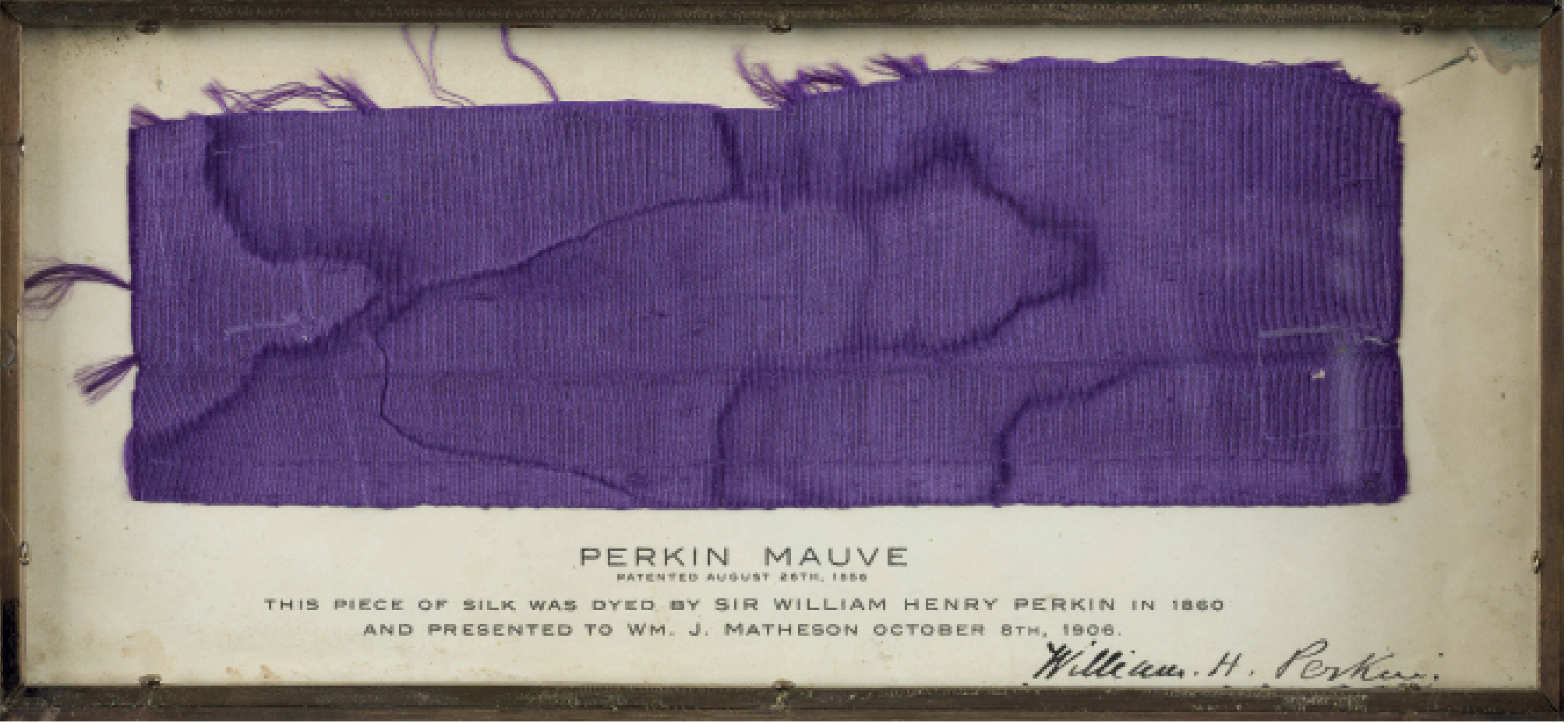
Fragment of silk dyed with mauveine.
Despite the great commercial success of dyes, the chemical industry did not take off in the United Kingdom. It was Germany that captured the primacy of organic synthesis thanks to the enormous quantities of coal tar available (especially in the Ruhr Valley, where it also presented an environmental problem). The German chemical industry was also quite dynamic entrepreneurially. From the early twentieth century, it began to group into consortia, culminating in the 1926 formation of a single, massive national chemical industry: Interessen-Gemeinschaft Farbenindustrie AG (better known as IG Farben), which incorporated BASF, Bayer, Hoechst, Agfa, Chemische Fabrik Griesheim-Elektron, and Chemische Fabrik vorm.
The national German industry suffered severe losses after World War I, but IG Farben managed to maintain—and even grow—its turnover, entering Adolf Hitler’s chancellorship in more than flourishing condition. However, the situation was complex. Carl Bosch, the engineer leading IG Farben and a 1931 Nobel Laureate in Chemistry, had taken an enormous risk by building a plant in Belgium for producing fuel via the hydrogenation of carbon extraction by-products. The fuel produced at the Leuna plant cost at least five times more than that obtained from petroleum in, for example, the United States. Furthermore, IG Farben was under fire from the National Socialist party, whose electoral strength seemed unstoppable, due to its large contingent of Jewish workers.
As an industry captain, shortly before the 1932 elections, Bosch requested and obtained a meeting between his corporate leadership and Hitler to present the coal hydrogenation project. Hitler, surprisingly well-informed, showed great interest, emphasising its importance for making Germany energy self-sufficient. The 1932 elections resulted in a fragmented German parliament unable to form a stable government. New elections in March 1933 allowed Hitler to become Chancellor, and at that point, Bosch had to meet him officially, agreeing that the Chancellor’s support for the synthetic fuel project would never waver.
But Hitler demanded the expulsion of all Jewish scientists and workers from IG Farben. Reluctantly and not without initial opposition, Bosch had to yield. Among the victims of the racial laws was the inventor of ammonia synthesis, Fritz Haber, who died in disgrace the following year.

Extract from the minutes of the Nuremberg Trials.
Despite the racial laws impacting IG Farben’s productive capacity, the proximity to the regime grew, eventually making the enormous chemical industry the largest financier of the Nazi party. This brought great advantages to both sides. The German army benefited from the supplies of the flourishing IG Farben, and the latter acquired new companies—using methods as summary as Hitler’s. The day after the annexation of Austria in 1938, IG Farben seized Skoda Werke Wetzler, the main Austrian chemical industry. The same happened to the Aussinger Verein chemical industry in Czechoslovakia and then in Poland in 1939, where the giant—now fully organic to Nazism—took possession of three industries: Boruta, Wola, and Winnica.
Auschwitz and the Loss of Innocence
In the heart of World War II, Hitler’s Pan-Germanic and expansionist ambitions had simultaneously opened three war fronts—Poland, France, and Great Britain—which were extremely costly in terms of raw materials and fuel. The Nazi machine temporarily paused at the insistence of the generals, who demanded sufficient supplies to defeat the Red Army before the Russian campaign. A substantial procurement plan for munitions, fuels, and rubber was needed, requiring the urgent construction of new, large chemical plants.
The choice of production sites was entrusted to Otto Ambros, an expert in the production of polybutadiene, a synthetic rubber obtained from the polymerisation of butadiene (Bu) using a sodium catalyst (Na). This was essential for producing tyres for transporting supplies and troops. The choice narrowed to two similar sites: the first in Norway and the second in the Silesia region of Poland. They were essentially equivalent: nearby coal mines ensuring raw material supply, abundant water for industrial use from rivers, and a network of highways and railway lines ensuring easy transport of goods and people.
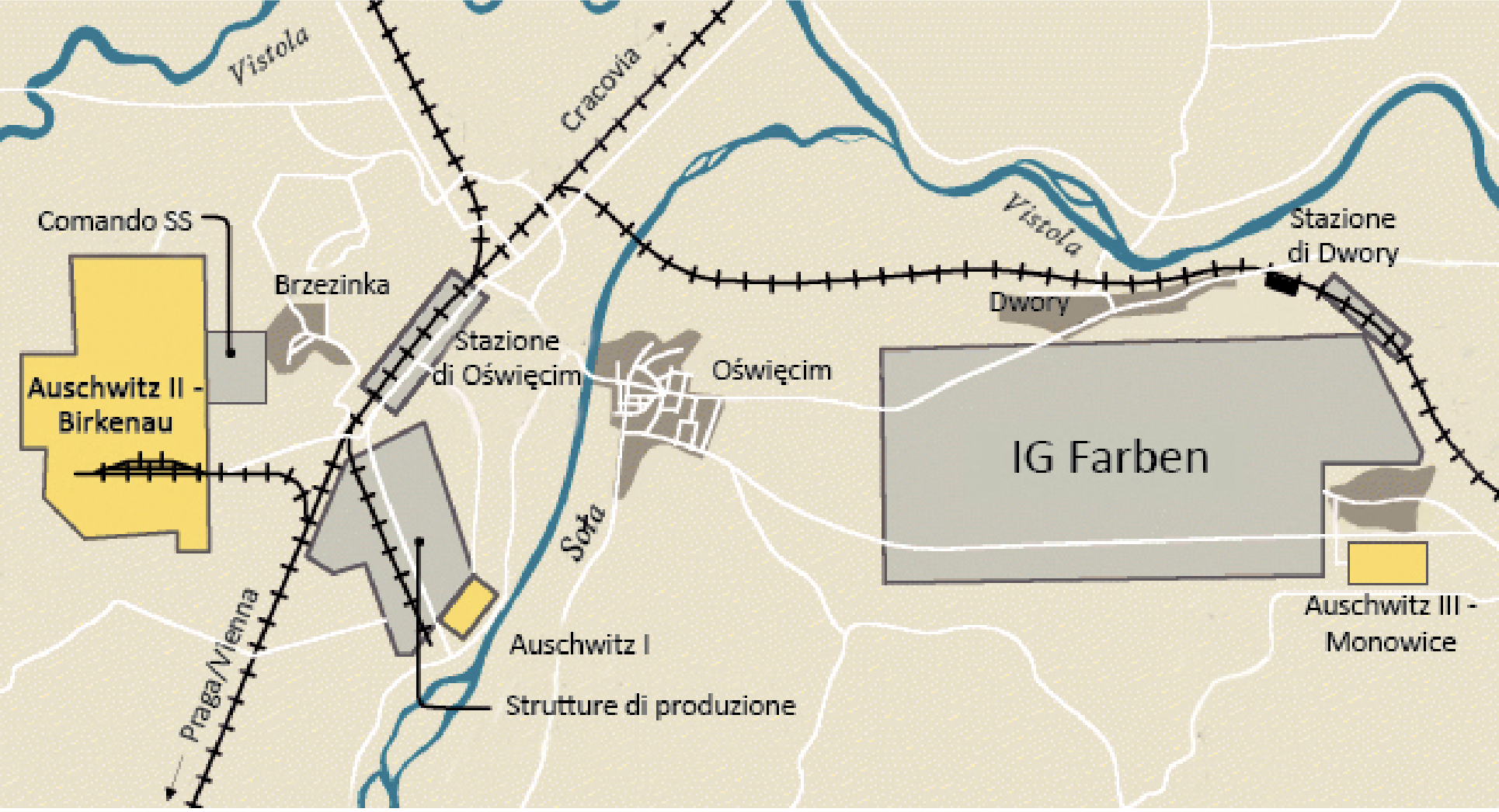
Auschwitz-Birkenau site.
In the heart of World War II, Hitler’s Pan-Germanic and expansionist ambitions had simultaneously opened three war fronts—Poland, France, and Great Britain—which were extremely costly in terms of raw materials and fuel. The Nazi machine temporarily paused at the insistence of the generals, who demanded sufficient supplies to defeat the Red Army before the Russian campaign. A substantial procurement plan for munitions, fuels, and rubber was needed, requiring the urgent construction of new, large chemical plants.
The choice of production sites was entrusted to Otto Ambros, an expert in the production of polybutadiene, a synthetic rubber obtained from the polymerisation of butadiene (Bu) using a sodium catalyst (Na). This was essential for producing tyres for transporting supplies and troops. The choice narrowed to two similar sites: the first in Norway and the second in the Silesia region of Poland. They were essentially equivalent: nearby coal mines ensuring raw material supply, abundant water for industrial use from rivers, and a network of highways and railway lines ensuring easy transport of goods and people.
The real difference, as usual, was made by money, the “dung of the devil” according to Paul the Apostle. In Silesia, near the future industrial site, there was already a small prison camp that the SS had decided to expand, which would provide free labour to the BuNa (or Buna) plant. For IG Farben, this meant an immediate saving of at least 5 million marks on the construction of worker barracks, in addition to salaries. It was decided: the new plant would be built at Auschwitz, in a district populated by about 25,000 inhabitants, of whom, as the inspection reports noted, “only 2,000 of German race and 7,000 Jews.”
In Silesia, southern Poland, near the current Czech Republic and Slovakia, flows the Soła river. The Auschwitz I camp, the original SS site, stands right along the railway line connecting Prague and Vienna to Krakow. The small station of Oświęcim (Auschwitz in Polish) is just under 5 km from the industrial site. The surrounding conditions were perfect, but they had to hurry; the Russian campaign was imminent. IG Farben saw a new, huge market for polyethylene and fuels in the expansion eastward, toward the Soviet Republics; the potential profit could be staggering.
Deadly Embrace
The union with Nazism became indissoluble, and the chemical giant compromised itself irrevocably by asking Hermann Wilhelm Göring to supply between 8,000 and 12,000 low-cost workers for the site’s construction. Following the chain of command, it was Heinrich Himmler who ordered the SS of the Auschwitz I camp “to contact the construction managers to help the project by means of the concentration camp prisoners in every possible way.” The agreement involved paying three marks per day for each worker; four for those with experience, and one and a half marks for children. Money—it should be clear—to be paid to the SS.
Despite the SS’s efforts to provide human material for the site’s construction, progress was slow because the brutal methods used on the prisoners proved counterproductive. This represented the turning point: with almost a billion marks invested in the project, IG Farben needed certainty on timeframes and took a further step into the abyss, deciding to build its own prison camp right next to the factory. Thus, in the summer of 1942, the Auschwitz III site in Monowice was completed, managed by IG Farben, in perfect harmony with the methods of the SS.

The arrival of the train with the deportees inside the Auschwitz-Birkenau camp, 1944.
Meanwhile, the Auschwitz II-Birkenau camp had begun operating at full capacity, where the gas chambers and crematoria for the so-called “Final Solution” to the Jewish Question had been built. The presence of the Birkenau site posed a practical problem for the labour supply: managers at the Buna site complained that on some occasions, over 80% of the approximately 5,000 Jewish deportees arriving at the Auschwitz III station were taken to the gas chambers, and only 20% were sent to the Monowice site—a decidedly insufficient number. Thus, the descent into hell deepened, and IG Farben secured an agreement that deportees would arrive directly at the Dwory station, adjacent to the industrial plant. The selection of Jewish prisoners to be kept alive was performed by IG Farben personnel, and the percentage of selected workers, who faced a life of hardship that the camp doctors themselves predicted would not last beyond three months, rose to 50%. Approximately 25,000 deportees worked until death for IG Farben.
Häftling 174 517
Primo Levi recounts leaving the Fossoli camp on February 21, 1944, boarding a train in Carpi, and arriving at Auschwitz about two weeks later. Primo Levi, now identified by the tattoo 174 517, reached the IG Farben station and was selected among the few deemed fit for labour—96 men and 29 women out of over 500 who had left Fossoli. There, he was told: “We are at Monowice, near Auschwitz… This is a labour camp and all ten thousand prisoners work for a rubber factory called Buna.” The German chemical industry had thus met the Italian chemist.
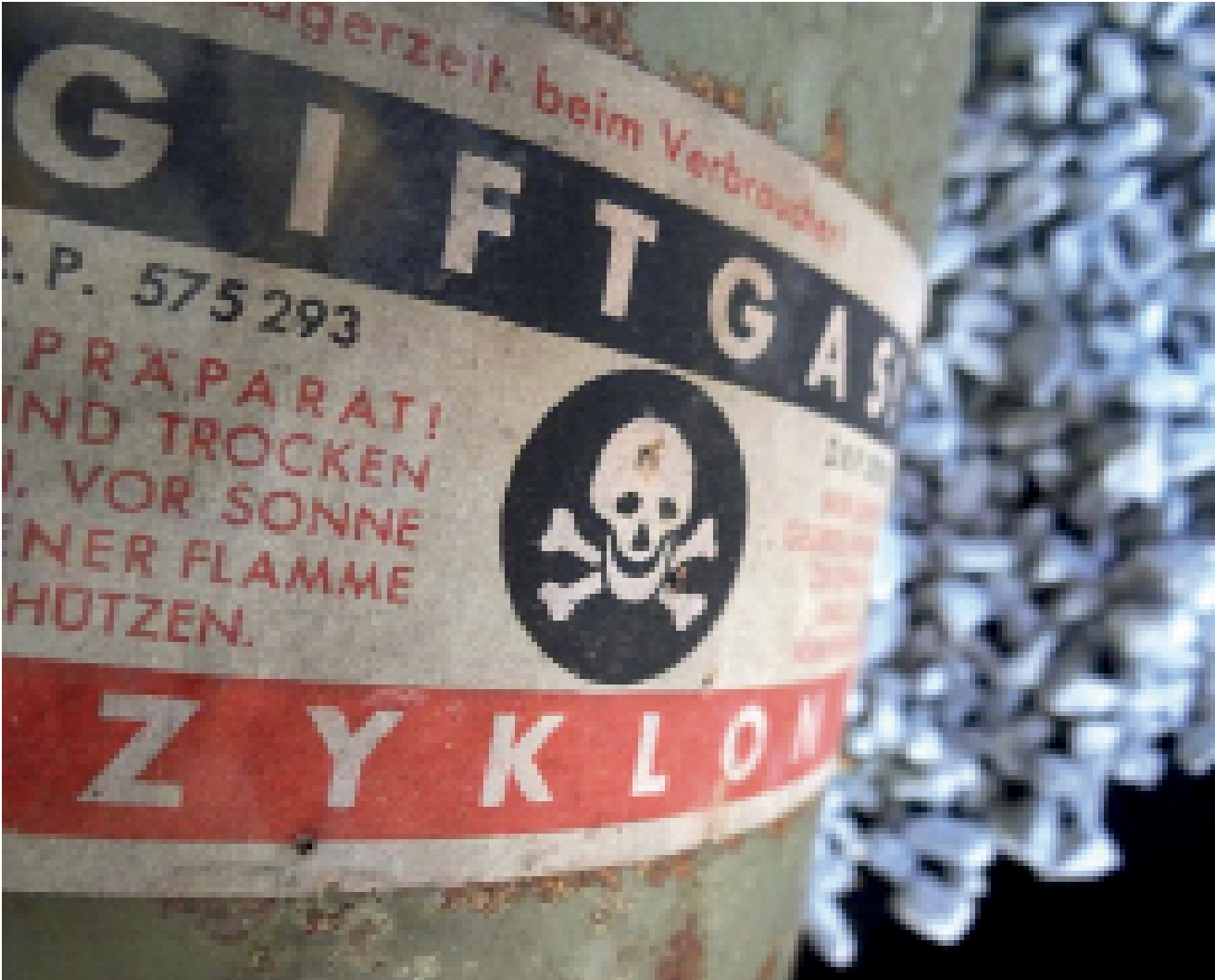
Zyklon B label.
“I graduated [in chemistry] in Turin in 1941, summa cum laude,” Primo Levi replied to the polymer chemist—Doktor Ingenieur Pannwitz—who was questioning him to verify that the prisoner was not falsely claiming his education. Having passed the examination, Levi joined Kommando 98, the Chemistry Kommando. The winter of 1944 had already begun when Primo Levi and two other prisoners were informed that they had been selected for the Buna chemical analysis laboratory. An unexpected stroke of luck that immediately secured him a new shirt and underwear and a weekly turn with the barber. Additionally, Levi recounts that “the temperature in the laboratory is wonderful: the thermometer reads 24 degrees [C].”
Auschwitz and Prussic Acid
During the few moments when he had the chance to look around, Primo Levi could see the chimney towering over the Auschwitz II-Birkenau site from the Auschwitz III location. Birkenau was the destination for deportees who were unable to provide labour for the Buna plant. Birkenau is the place where the Final Solution to the Jewish Question reached its apex, one of those places where one can truly speak of hell on earth.
In August 1941, to speed up the extermination—which had already begun in the Treblinka camp using carbon monoxide gas chambers—Commander Rudolf Höß decided to introduce Zyklon B, the commercial name for prussic acid (hydrogen cyanide, HCN, in correct chemical nomenclature), purchasing it from the chemical company Degesch, which was 42.5% owned by IG Farben. Hydrogen cyanide was used in moderate quantities for controlling prisoners’ parasites, but it was legally required to be mixed with a powerful odorant agent to warn of the chemical compound’s danger. Höß instead asked Degesch to produce the compound without the olfactory indicator to use it without causing panic among the deportees locked in the gas chambers.
Hydrogen cyanide is a small molecule that, even at the rigid winter temperatures of Silesia, can reach concentrations about a thousand times higher than the lethal concentration for a human being. Poisoning is due to HCN binding to the membrane enzyme cytochrome oxidase (COX), which is involved in cellular respiration. Under physiological conditions, COX binds to an oxygen molecule and enables the formation of ATP, the energy molecule that ensures cell survival. In the presence of HCN, oxygen is no longer able to bind to the enzyme; the cell stops producing ATP and, as an immediate consequence, goes into hypoxia, causing the organism’s death. Unfortunately, it was a quick and effective method.
The Banality of Evil
Hannah Arendt’s idea that evil is produced unconsciously or through subservience already falters in the case of Adolf Eichmann, but it certainly does not hold up for IG Farben and the chemical industry involved in its tight embrace with Nazism. Can one be unaware that deportees not selected for Buna labour will be taken to the gas chambers? That deportees working in inhuman conditions have a life expectancy of three months? That removing the warning odour from Zyklon B leads to the death of anyone exposed to the lethal gas?
Reactions walk on the legs of chemists, who are aware and responsible for their actions.
IG Farben and its directors were brought before the Nuremberg War Crimes Tribunal, but only twelve were found guilty and sentenced to derisory terms ranging from one to two years. In a couple of cases, eight years in prison. Nothing compared to their crimes. Many of the convicted individuals later resumed prominent positions in the companies into which IG Farben was dismantled at the end of the conflict.


In questa categoria
Open Access